
WORDPRESS
Shopify Plus vs WooCommerce for Large Catalogs: Cost, SEO & Scalability Breakdown
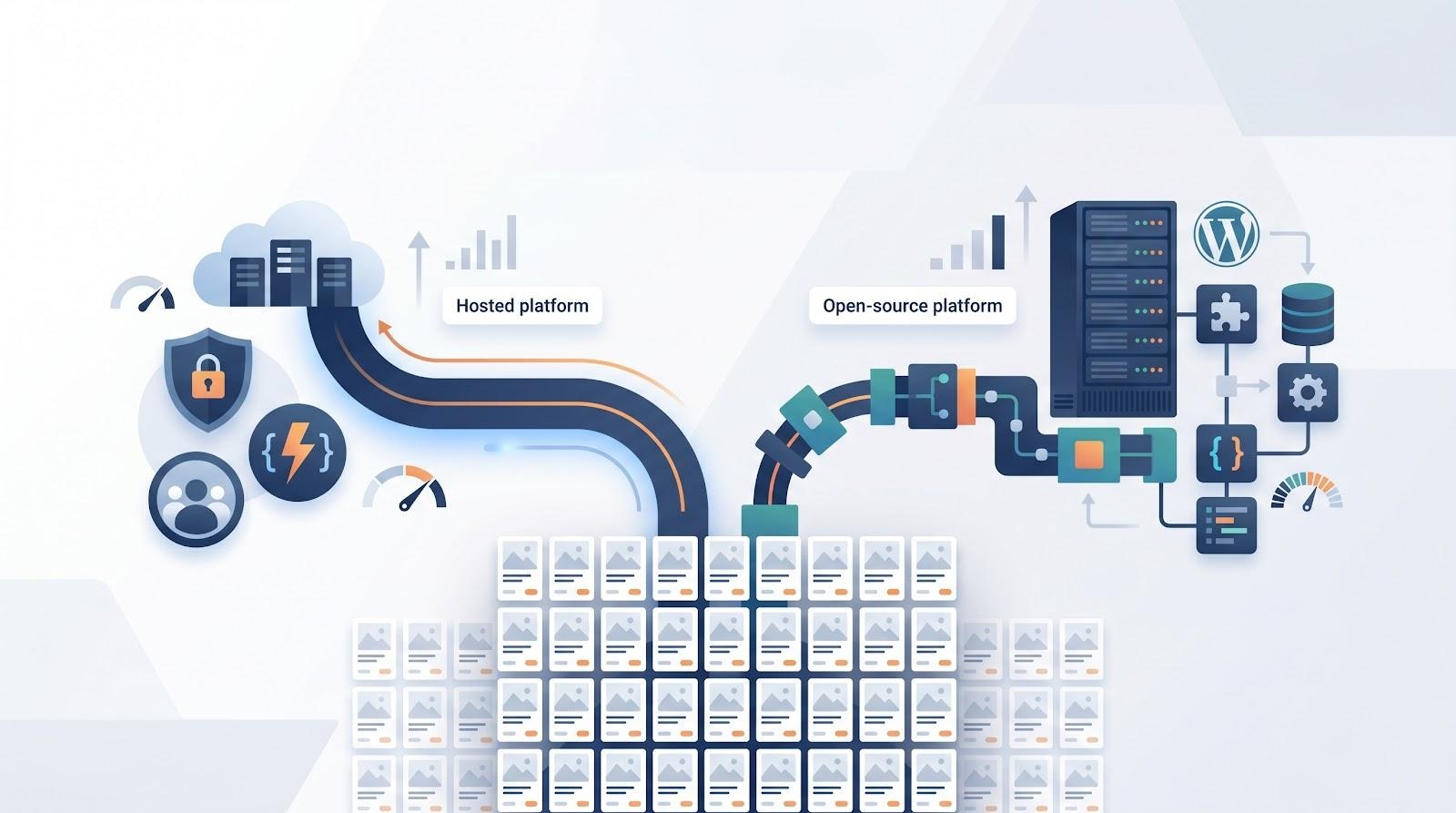
Running a 10-SKU shop is a breeze. Scaling to 100 k products can tank load times, dent rankings, and erode revenue.
You’re probably staring at a wall of SKUs asking, “Which platform won’t buckle as we grow?” Two names dominate that debate: Shopify Plus, the hosted workhorse built for traffic spikes, and WooCommerce, the open-source engine that swaps turnkey ease for total control.
This guide pits them head-to-head on three mission-critical fronts – total cost of ownership, search visibility, and real-world performance – using fresh 2026 benchmarks and hard cost models. We’ll even flag moments when expert partners like Never Settle, a top 1 percent Shopify Plus agency that specializes in large-catalog builds, can accelerate roll-outs and de-risk migrations.
Ready to find out which platform stays cool under a six-figure catalog? Let’s dive in.
Shopify Plus and WooCommerce at a glance
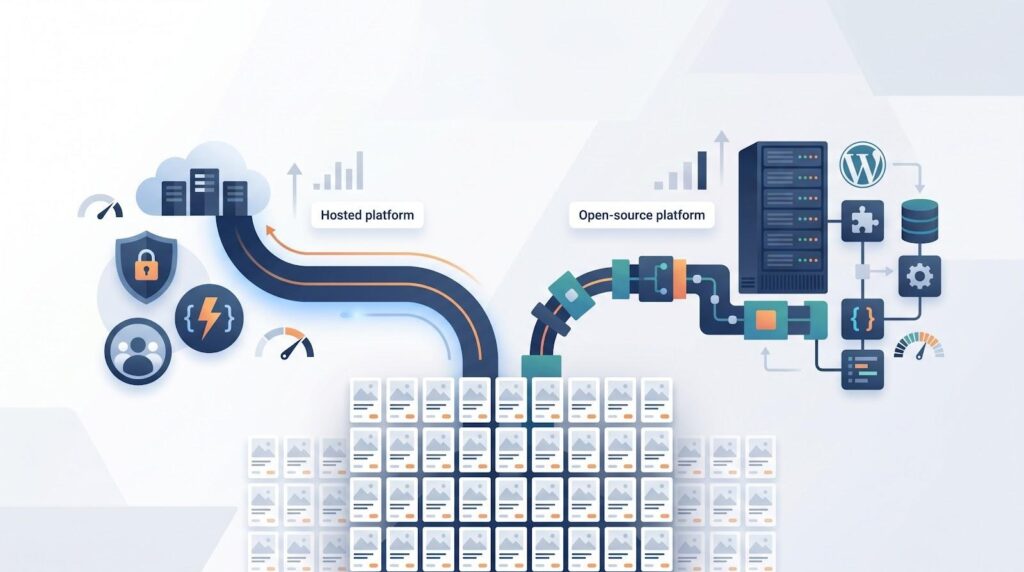
Think of this as the scene-setter. Before we dig into cost, SEO, or speed, we need a crisp sense of what each platform is and how it treats six-figure catalogs.
Shopify Plus is a hosted service. Your store, database, and checkout all live on Shopify’s global infrastructure. Traffic spikes, security patches, and PCI compliance stay behind the curtain while you focus on merchandising. Plus also unlocks enterprise extras such as unlimited staff accounts, 20 API calls per second for bulk work, and checkout UI extensions that let you fine-tune the crucial payment funnel.
WooCommerce flips that model. It’s software you own. You install it on WordPress, pick a host, and decide exactly how the code behaves. High-Performance Order Storage (HPOS) moved orders to dedicated tables in 2023, making large-volume stores far snappier. Every theme, plugin, or server tweak is under your control, which is a blessing if you have engineering muscle and a burden if you don’t.
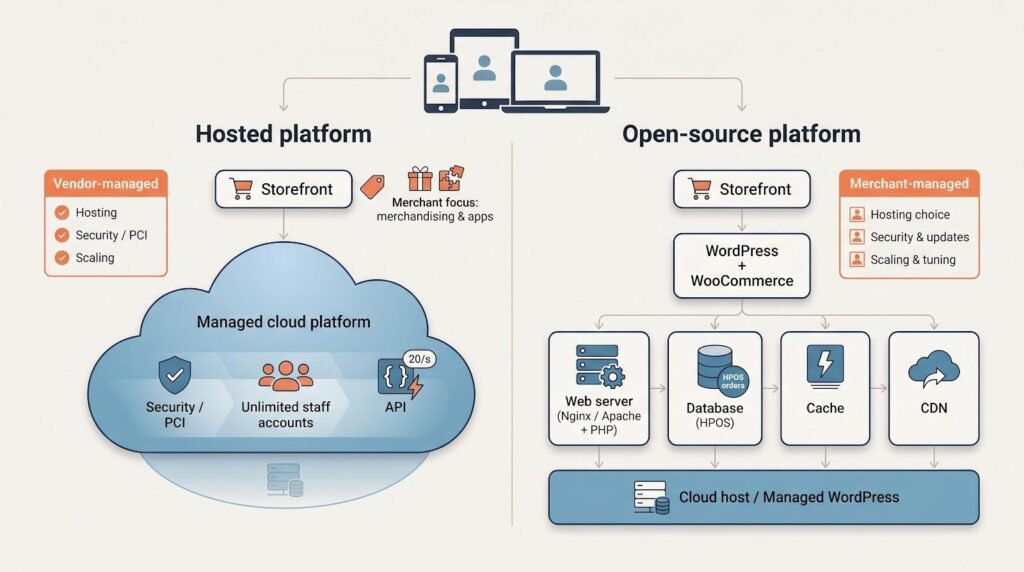
Money sets the tone. According to Zipchat’s 2026 Shopify Plus pricing guide, Shopify Plus starts at $2,300 per month on a three-year term, and pricing switches to a 0.25 percent platform fee on total monthly revenue once sales exceed $800,000. WooCommerce’s core is free, so the headline cost is your hosting bill and any premium extensions you add. In practice, that can be as low as a few hundred dollars a month or as high as you choose, but you decide where the ceiling sits.
Finally, consider ownership. With Plus, Shopify owns the roadmap and the rules, so you ride their wave. With WooCommerce, you steer the ship entirely. That single philosophical difference shapes everything that follows.
Shopify Plus: what your wallet really feels
Shopify Plus seems simple on the surface: you pay a flat $2,300 each month on a three-year term. Two extra tolls, though, belong in every budget.
First is revenue share. Once monthly sales pass $800,000, pricing switches to 0.25 percent of your total monthly revenue. At eight-figure run rates that fee can dwarf the base subscription.
Second is the “app tax.” Enterprise stores seldom run stock. Most add search, merchandising, automation, and B2B extensions that tack on $500 to $2,000 in new subscriptions every month. A 2026 benchmark from 20North Marketing shows the impact: a typical Plus store spends $6,000 to $24,000 per year on apps for advanced search, loyalty, and B2B features.
That real-world Plus price tag belongs on your spreadsheet before you even factor in payment processing.
WooCommerce: where the savings come from
WooCommerce has no sticker price. While that can sound like a gimmick, the absence of a license fee truly shifts the cost curve downward.
Start with hosting. A high-performance managed WooCommerce plan that can serve a six-figure catalog usually costs between $40 and $300 a month for optimized infrastructure. Add a content delivery network, and you’re still far below Plus pricing.
Next are extensions. Enterprise merchants typically spend $500 to $2,000 per year on premium plugins such as advanced search, subscriptions, and bulk editors that mirror Shopify’s paid apps. The key difference is cadence: most WooCommerce tools bill once per year, not every thirty days, so expenses scale slowly.
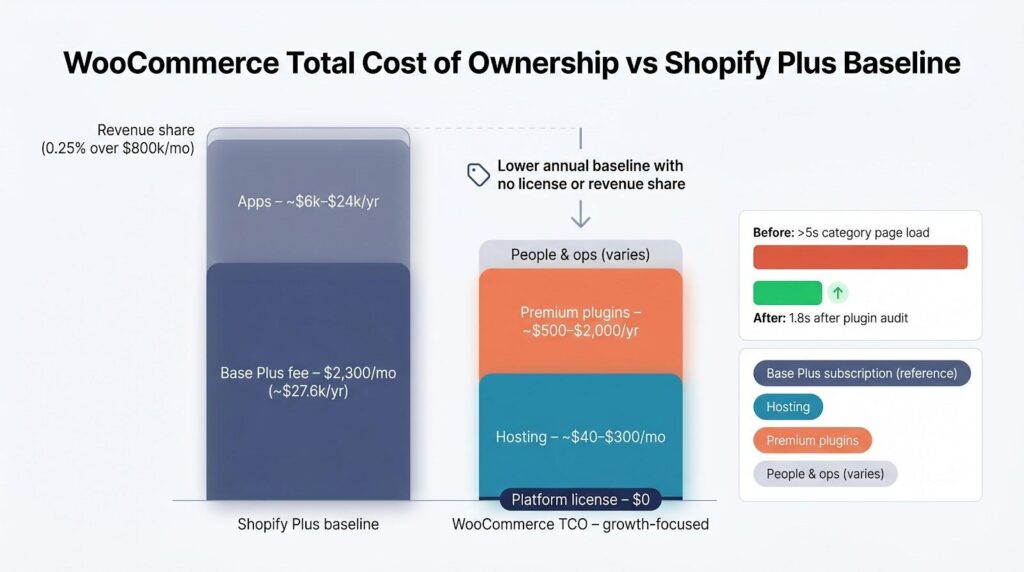
Never Settle’s recent performance audit of WooCommerce stores highlights why quality beats quantity in the plugin line-item.
During one investigation, disabling just a single visual-filter extension shortened a category-page load from over five seconds to 1.8 seconds and restored conversion rate.citeturn8view0
Put another way, the smartest $500–$2,000 you’ll spend on extensions each year is the part that keeps your site lean enough to avoid paying for bigger servers later.
People costs come next. Elementor’s 2026 pricing breakdown pegs the ongoing software and hosting costs for a growth-focused WooCommerce store at about $2,272 annually. That’s a fraction of Shopify Plus’s base outlay.
There’s no platform surcharge, no revenue share, and no penalty for choosing Stripe or a regional gateway. That single omission keeps operating expenses predictable even as order volume climbs.
SEO, content, and your fight for organic traffic
Technical building blocks
Search engines reward clean structure and quick delivery, so we start with the nuts and bolts.
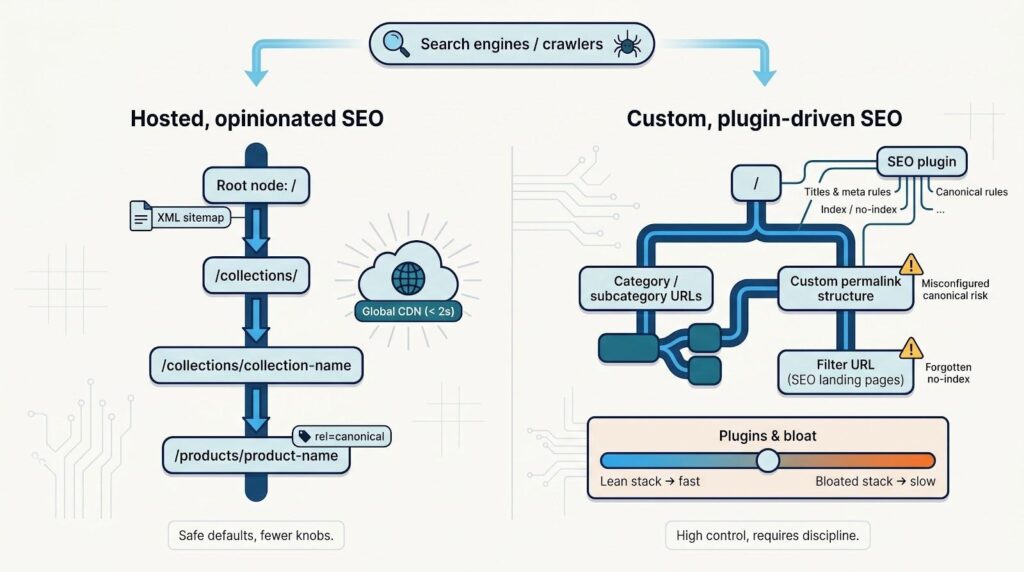
Shopify Plus ships with a fixed URL pattern. Products always live at /products/ and collections at /collections/. You can’t rename those folders, but you also never worry about broken links because the platform builds canonical tags and sitemaps for you. Paired with Shopify’s global CDN, that setup often delivers sub-two-second load times, a Core Web Vitals win that feeds ranking signals.
WooCommerce works the opposite way. Every permalink component is yours to edit. You can nest products deep in a category tree or strip the slug to a single keyword. WordPress SEO plugins then let you adjust titles, meta descriptions, and index rules in bulk. That freedom lets experienced teams craft ideal crawl paths, prune thin pages, and spin up SEO landing pages for high-value filter combinations.
The trade-off is discipline. With great power comes the risk of mis-configured canonicals, forgotten no-index tags, or plugin bloat that slows the site. WooCommerce hands you the steering wheel; Shopify locks you into safe lanes but paves the road.
Content that wins links and customers
Google craves depth, and shoppers crave guidance, making content marketing the silent engine behind most high-SKU success stories.
WooCommerce runs on WordPress, the world’s most battle-tested blogging platform. You get categories, tags, custom post types, and a rich visual editor straight out of the box. Need a buying guide for every sub-category or a seasonal lookbook with embedded products? You can publish like a media company and link to any SKU in seconds. Large teams value the familiar workflow: draft, schedule, revise.
Shopify’s blog feels minimalist by comparison. It supports posts and tags but skips true categories and advanced custom fields. Serious publishers often bolt on a headless CMS or keep WordPress on a subdomain, which splits analytics and authority. For leaner teams, though, that simplicity is a benefit. You concentrate on new arrivals instead of content architecture, and every post inherits the storefront’s speed.
The numbers back the split. Studies show WooCommerce stores capture broader long-tail keyword sets because owners ship more content, faster. Shopify counters with quicker load times and a growing library of built-in rich snippets that lift click-through rates on product pages.
Choose the environment that matches your marketing culture. If you treat content like oxygen, WooCommerce supplies an endless flow. If you publish only the occasional promo article and prefer turnkey speed, Shopify is more than good enough and never in the way.
Scalability and performance
Infrastructure and hosting: where the heavy lifting happens
Shopify Plus hides the servers from view. Your catalog sits on the same auto-scaling fabric that handles millions of Black Friday checkouts. Static assets live on a global CDN, while dynamic requests route to clusters that grow the moment traffic surges. You don’t size databases, patch PHP, or worry about regional latency; the platform folds those chores into the monthly fee.
Because the stack is shared and battle-tested, Shopify publishes guardrails instead of raw capacity numbers. A recent limits guide confirms there’s no hard product cap, and real-world merchants run well past 100 k SKUs without custom engineering. According to Ecommerce Today, variant ceilings have also climbed: what was once 100 variants per product now reaches 2,048 when you use the GraphQL Admin API.
WooCommerce takes the DIY path. Scale lives or dies on your hosting plan, caching layer, and database tuning. A well-provisioned managed WordPress stack – think Nginx, PHP 8, Redis object cache, and a CDN – can serve tens of thousands of concurrent shoppers smoothly. High-Performance Order Storage moves order data to dedicated tables, cutting query time and keeping admin screens responsive even after holiday spikes.
The upside is freedom. Need a read-replica database for reporting or an Elasticsearch cluster for lightning-fast search? Spin them up and wire them in. The downside is responsibility. If a flash sale triples checkout volume and your server limits max out, shoppers feel the lag until you add more horsepower.
So the split appears again. Shopify Plus offers effortless, vendor-managed scale at a premium. WooCommerce offers limitless but owner-managed scale at whatever blend of time, talent, and cloud credits you’re willing to spend.
Flexibility, customization, and ecosystem
Shopify Plus sticks to guard rails. You can swap themes, add custom sections, and, on Plus, rewrite the checkout with sanctioned UI extensions. You can’t touch the core engine. Database schema, payment flow, and performance tuning remain in Shopify’s hands. That limit feels freeing when you want to launch a promo by Friday, yet frustrating if you need a fully bespoke product builder or an unusual ERP handshake.
WooCommerce opens every file. Hooks and filters let developers replace pricing logic, tax rules, or even the way products are stored. Need a rental calendar, a loyalty system that talks to your mobile app, or country-by-country bundle rules? You can build them, ship them, and own the IP. The flip side is maintenance: each piece you customize is another item to test when WordPress releases an update.
Apps versus plugins continues the theme. Shopify’s App Store curates about eight thousand add-ons, many with Plus certification. They install in minutes, charge monthly, and rarely break during platform upgrades. WooCommerce leans on the wider WordPress ecosystem with more than seventy thousand plugins of mixed quality. You’ll find a tool for almost anything, often at a one-time or annual fee, but vetting and support rest on your shoulders.
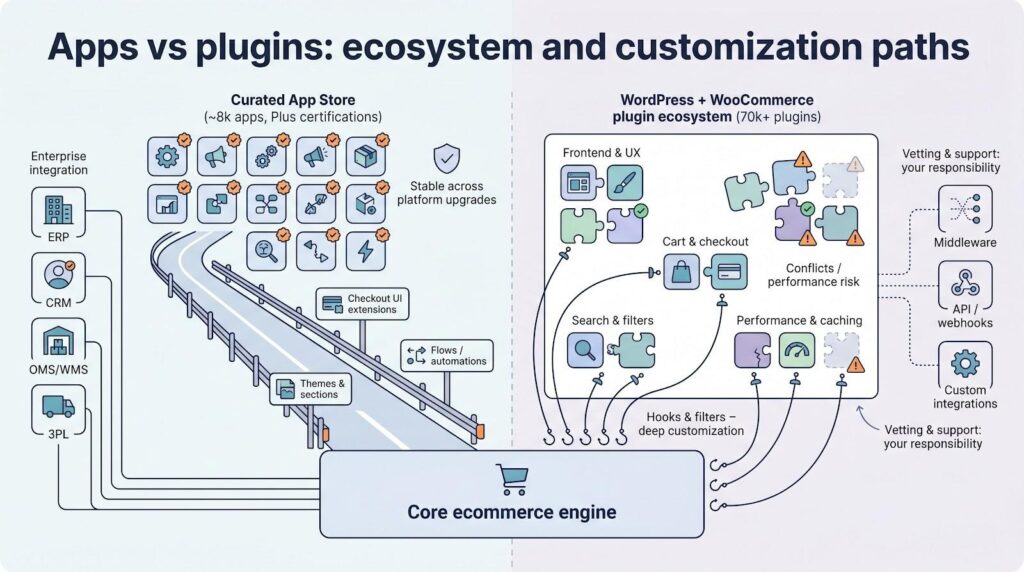
Integration paths differ too. Shopify Plus offers higher API limits, single sign-on, and a growing library of pre-built connectors for NetSuite, SAP, and Microsoft Dynamics. WooCommerce exposes REST and GraphQL APIs and works happily behind middleware such as Mulesoft or Zapier. Nothing is off limits, but everything is your job to wire together.
Choose the sandbox that matches your appetite for control. Shopify removes obstacles so non-technical teams can sprint. WooCommerce hands power users an open canvas, ideal when you have developers on call and risky when you don’t.
Stay in the loop with Entireweb
Get the latest updates delivered straight to your inbox. No spam - unsubscribe anytime.