The Nones: Nigeria

Nonbelievers in Nigeria said they perennially have been treated as second-class citizens in the deeply religious country whose 210 million population is almost evenly divided between Christians dominant in the south and Muslims who are the majority in the north. While the south is relatively safe for nonbelievers, some say threats and attacks have worsened in the north since the leader of the Humanist Association of Nigeria, Mubarak Bala, was arrested and later jailed for blasphemy.
The Associated Press spoke to seven nonbelievers to document their experiences. Most spoke anonymously and in secret locations over concerns for their safety.
“Bala’s imprisonment rolled our movement underground,” Leo Igwe, a founder of the humanist association, said of the group’s leader, who in 2022 was jailed for 24 years. A court convicted him on an 18-count charge of blaspheming Islam and breach of public peace through his posts on Facebook.
Mubarak Bala
Since Bala was prosecuted by the Kano state government, the humanist association — which has several hundred members— has gone underground, struggling with unprecedented threats to members who no longer hold meetings, Leo said.
Nigeria’s constitution provides for freedom of religion and expression, but activists say threats to religious freedom are common, especially in the north.
Almost half of the countries in Africa, including Nigeria, have statutes outlawing blasphemy. In most secular courts in Nigeria, the stiffest penalty for a blasphemy charge is two years in prison, while it carries a death penalty in the country’s Islamic courts, active in the majority Muslim north.
There are no records of any such executions in recent years. The most recent instance of a death sentence, issued in December against an Islamic cleric, Abduljabbar Nasiru Kabara, has not been carried out.
The Shariah law that operates in Islamic courts defines blasphemous acts as those committed by anyone who “intentionally abuses, insults, derogates, humiliates or seeks to incite contempt of the holy Prophet Muhammad.”
But what exactly constitutes actions that insult Islam is often open to interpretation by accusers, Igwe said. As a result, some alleged offenders have been attacked and killed before any trial.
At least three people have been killed for alleged blasphemy in northern Nigeria in the past year. The latest victim, killed in June, was a Muslim stoned to death after being accused of making comments that blasphemed Islam during an argument at a market. Those who stoned him included children, according to a video reviewed by the AP.
Authorities in Nigeria have failed to act to prevent such attacks, and prosecutions have been rare, said Isa Sanusi, director of Amnesty International in Nigeria.
“The alarming uptick in blasphemy killings and accusations underscores the urgency with which the authorities must wake up to Nigeria’s international legal obligations to respect and protect human rights, including freedom of religion,” Sanusi said.
Perpetrators of such attacks are ignorant of Islamic teachings, which discourage violence and do not compel anyone to become an adherent unwillingly, said Professor Usman Dutsinma, deputy director of the Center for Islamic Civilization and Interfaith Dialogue at Kano’s Bayero University.
“The best thing you can do is to subject him to reasoning,” Dutsinma said of nonbelievers. “But if somebody denounces Islam … some punitive measures must be taken against him. That is what Islam provides.”
Threats against the nonreligious in Nigeria are common on social media. On a Facebook group named Anti-Atheist, users frequently posted messages that trolled or threatened atheists, using the Hausa language of northern Nigeria.
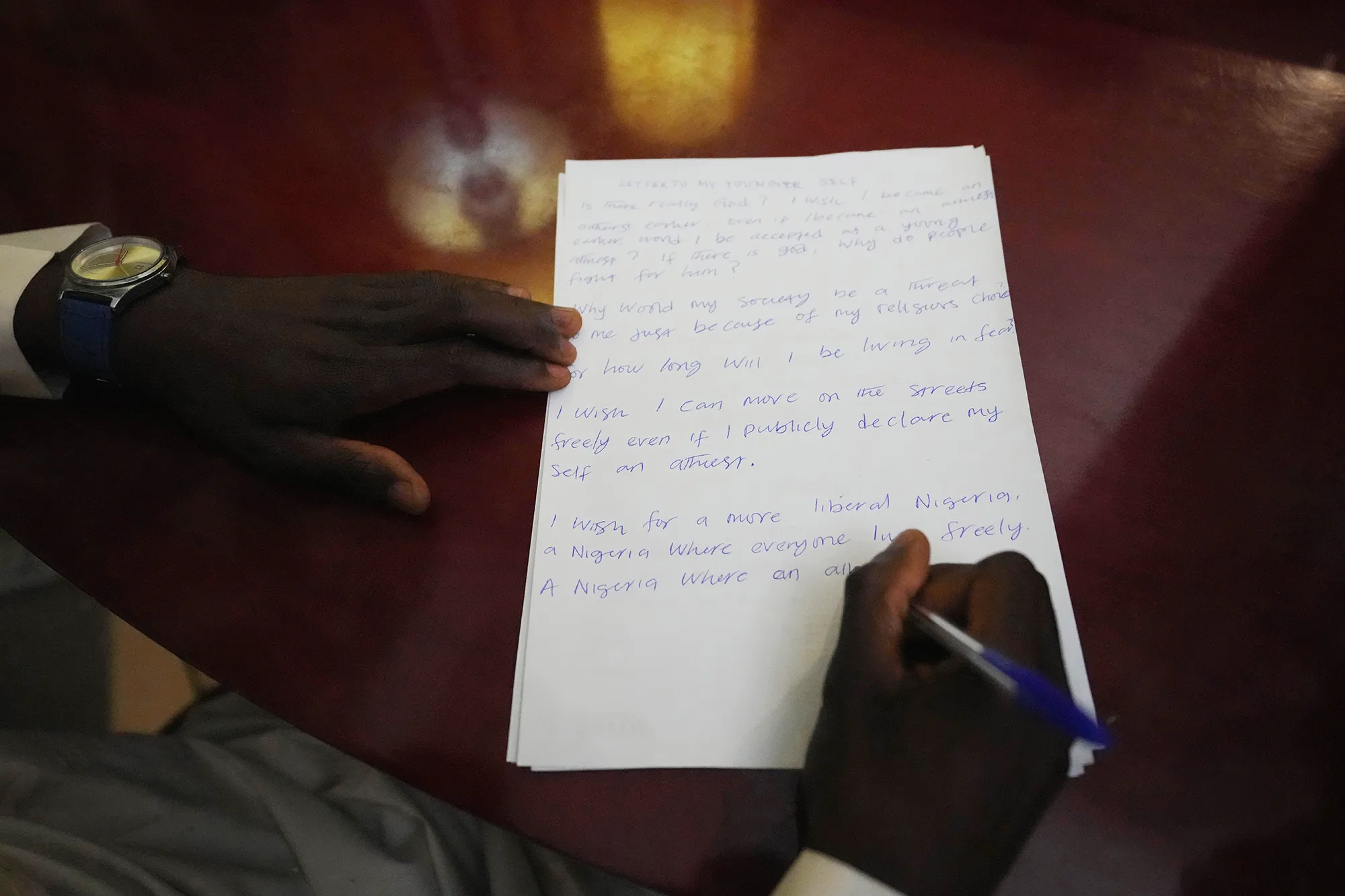
An atheist writes in Kone
The atheist in Kano, in a dimly lit room, spoke with a mix of grit and fear about his experiences as a nonbeliever in a nation where about 98% of the population are Christians or Muslims, according to the Pew Research Center. A Facebook post from Bala in 2015, critiquing some Islamic teachings, influenced the man’s shift to atheism.
The man said he then created a Facebook account with a fake profile with which he shielded himself as he regularly posted comments that questioned religion and advocated atheism.
“My biggest fear is for people I live with to know that I am an atheist,” he said.
Even his relatives are not aware he is an atheist, though his wife, a Muslim, accepts him as he is. “Her type is very rare,” he said.
Bala, once a Muslim, was seen as an influential member of the humanist community; most of the nonbelievers who spoke to the AP credited him as a source of inspiration. Until his conviction, he made several posts on Facebook that questioned religion, often attracting threats from other users.
In April 2020, he shared a post noting that he and other humanists in northern Nigeria “claim that there is no God.” One user called for Bala to face the death penalty.
Life as a nonbeliever in Nigeria is also difficult for women, who already are severely underrepresented in government and other key sectors.
“Your achievements are reduced to nothing if you are irreligious,” said Abosuahi Nimatu, who dropped out of university in Katsina state in 2020 to escape being killed after her peers learned she was no longer a Muslim.
Nimatu was so close to Bala that his prolonged detention depressed her for a year, she said. She used her Facebook account to campaign for his release, prompting threats that reached her cellphone and email inbox. Her home address was shared among people threatening to attack her and her family.
Even at home, there is scant comfort. She is often reminded that — as a female nonbeliever — no man would marry her.
“You are seen as a rebel and as a wayward person,” she said.
In 2020, Nigeria became the first secular democracy designated by the U.S. State Department as a “Country of Particular Concern” for engaging in or tolerating “systematic, ongoing, egregious violations of religious freedom.” It later was dropped from that list of countries, prompting criticism from the U.S. Commission on International Religious Freedom, which says Nigeria should be re-added.
“Religious freedom conditions in Nigeria remained poor as both state and non-state actors continued to commit widespread and egregious religious freedom violations,” the commission said in its 2022 annual report.
Sometimes, such intolerance comes from one’s family.
A man from Yobe state said he was forced to leave home in 2019 when his uncle found out he belonged to an atheist group on WhatsApp, prompting death threats. He returned home only after pretending to be a practicing Muslim even though he remained a closeted atheist, with Bala a strong supporter.