AI
Optimizing Your Website for AI Crawlers: A Practical Guide for the Next Era of Search and Citations
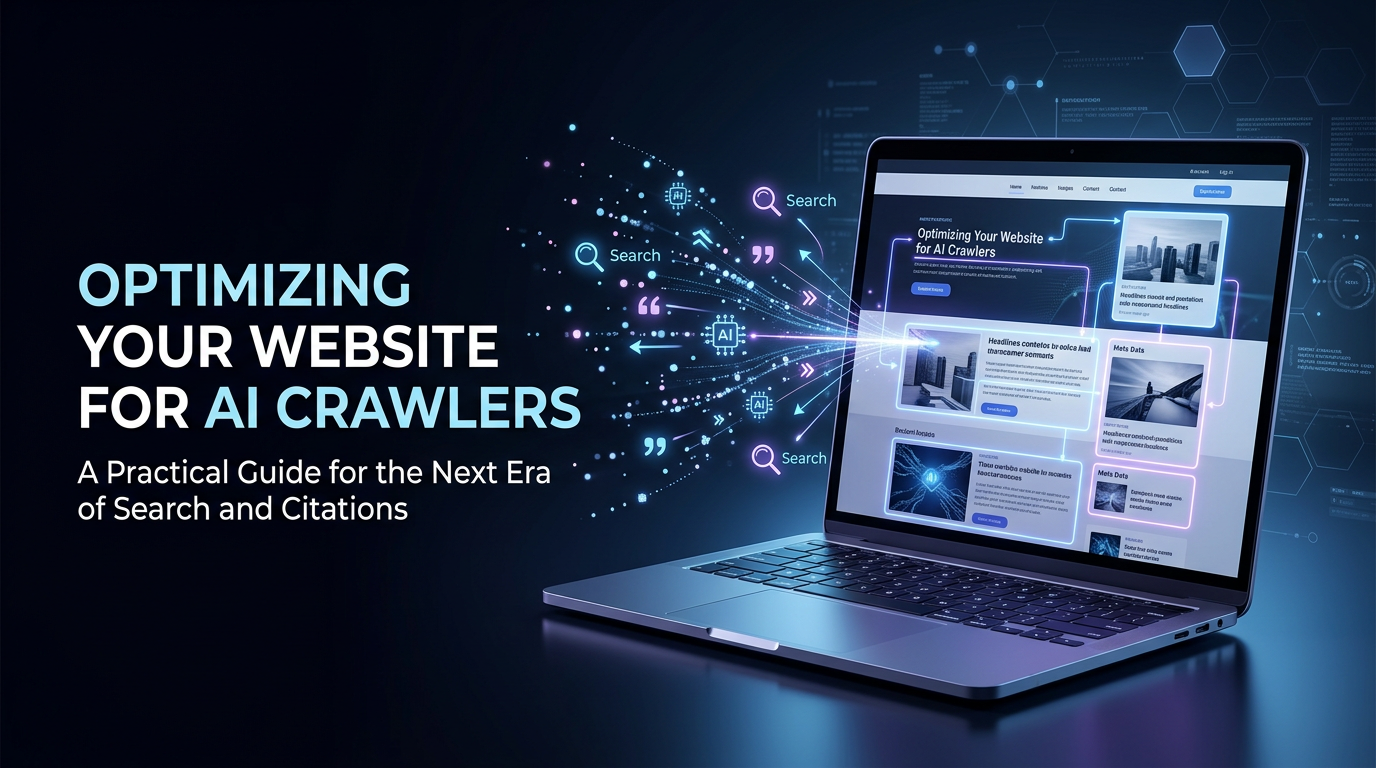
As artificial intelligence systems become increasingly integrated into search engines, virtual assistants, and research tools, a new type of “visitor” has emerged for websites: AI crawlers. Unlike traditional search engine bots that primarily index pages for ranking in search results, AI crawlers often aim to understand, summarize, and cite content directly in generated answers. This shift changes how websites should be structured, published, and maintained.
Optimizing for AI crawlers is not just an extension of SEO – it is a broader discipline focused on machine readability, semantic clarity, and structured accessibility. Websites that adapt early will be more likely to be cited, summarized correctly, and used as authoritative sources in AI-generated responses.
This article outlines how to prepare your website for this new ecosystem.
1. Understanding AI Crawlers and Their Goals
AI crawlers – used by systems like large language models, AI search assistants, and retrieval-augmented generation (RAG) systems – are designed to:
- Extract factual and contextual information
- Summarize content accurately
- Identify authoritative sources for citation
- Retrieve structured and unstructured data efficiently
Unlike traditional search indexing, AI systems often break content into chunks and embed it into vector databases. That means clarity, structure, and context matter more than keyword density.
In short: you are no longer just writing for ranking – you are writing for interpretation.
2. Make Your Content Structurally Machine-Friendly
Use semantic HTML
AI crawlers rely heavily on HTML structure to understand meaning. Proper semantic tags help models interpret relationships between sections.
Use:
<article>for main content<header>for titles and summaries<section>for grouped ideas<h1>–<h3>for hierarchical structure<aside>for supplementary information
Avoid dumping content into generic <div> blocks without structure.
Maintain logical hierarchy
A clear heading structure is essential:
- H1: Main topic
- H2: Key sections
- H3: Subtopics and supporting detail
This allows AI systems to chunk content correctly and attribute information accurately.
3. Write for “Chunkability” and Context Independence
AI models often retrieve only parts of a page, not the whole document. This means each section should be understandable in isolation.
Best practices:
- Start sections with clear topic sentences
- Avoid vague references like “this method” or “as mentioned above” without context
- Repeat key context where necessary
- Keep paragraphs focused on a single idea
For example, instead of writing:
“This improves performance significantly.”
Write:
“Optimizing image compression improves website performance by reducing page load times and lowering bandwidth usage.”
This makes extracted snippets more useful and citable.
4. Structured Data Is Critical
Structured data helps AI systems interpret content with high confidence. Implement schema markup wherever possible:
- Article schema for blog posts
- FAQ schema for question-based content
- Product schema for e-commerce
- Organization schema for brand identity
- How-to schema for instructional content
Using JSON-LD is the preferred method.
Structured data provides explicit meaning, reducing ambiguity for AI systems and increasing the likelihood of correct citation.
5. Improve Crawl Accessibility (robots.txt, sitemaps, and beyond)
robots.txt
Ensure AI crawlers are not unintentionally blocked. Many websites still restrict unknown bots too aggressively.
You should:
- Allow major known AI crawlers (where appropriate)
- Avoid blanket disallow rules unless necessary
- Clearly define crawl permissions
XML sitemaps
Keep sitemaps:
- Updated automatically
- Clean (no duplicate or broken URLs)
- Segmented for large sites (blog, products, docs)
Add content feeds
RSS/Atom feeds are still extremely useful for AI ingestion pipelines. They provide:
- Structured updates
- Clean content summaries
- Easy change detection
6. Consider Emerging Standards Like llms.txt
A growing discussion in the web ecosystem is the idea of an llms.txt file-similar to robots.txt, but designed to guide large language model behavior.
While not universally standardized yet, the concept typically includes:
- Which pages are preferred for AI citation
- Licensing or usage preferences
- High-value canonical content sources
- Sections to exclude from training or summarization
Even if not widely enforced yet, implementing a clear AI guidance file signals intent and future-proofs your site.
7. Optimize for Retrieval, Not Just Ranking
Traditional SEO focuses on ranking pages. AI optimization focuses on retrieval quality.
This means:
Use clear factual statements
AI systems prefer declarative, unambiguous sentences.
Avoid overly marketing-heavy language
Fluff content is often discarded during summarization.
Include definitions and explanations
Pages that define concepts clearly are more likely to be cited.
Use summaries
Add short summaries at the beginning or end of sections to improve extraction quality.
8. Performance Still Matters (More Than Ever)
Fast-loading pages are easier to crawl, parse, and index.
Key optimizations:
- Reduce JavaScript dependency for core content
- Use server-side rendering where possible
- Optimize images (WebP/AVIF)
- Minimize layout shifts (CLS)
- Ensure mobile-first design
Some AI crawlers may impose strict timeouts, meaning slow pages risk partial or failed ingestion.
9. Provide Alternative Access Paths (APIs and Data Endpoints)
One of the most powerful ways to optimize for AI systems is to offer structured data directly.
Consider providing:
- Public APIs for content access
- JSON endpoints for articles or products
- Downloadable datasets
- Markdown or clean text versions of pages
This reduces ambiguity and increases the likelihood that your content is used correctly in AI-generated responses.
10. Strengthen Content Authority Signals
AI systems attempt to prioritize trustworthy sources. You can improve perceived authority by:
- Citing original sources
- Adding author information and credentials
- Including publication dates and update logs
- Maintaining consistency across content
- Linking between related articles (strong internal linking)
The clearer your authority signals, the more likely your content is to be selected for citation.
11. Make Your Content Easy to Attribute
AI systems often prefer content that is easy to quote or summarize. To improve attribution:
- Use distinct, well-labeled sections
- Provide definitions and key takeaways
- Avoid mixing multiple topics in one paragraph
- Ensure originality and specificity
Content that is “cleanly extractable” is more likely to appear in AI answers.
12. Monitor How AI Crawlers Interact With Your Site
As AI traffic grows, traditional analytics may not be enough. You should:
- Monitor server logs for unusual bot behavior
- Identify known AI crawler user agents
- Track referral sources from AI platforms
- Evaluate which pages are being cited or summarized
This data will help refine your optimization strategy over time.
13. Common Mistakes to Avoid
Many websites unintentionally make themselves harder for AI systems to interpret. Common issues include:
- Overuse of JavaScript-rendered content
- Lack of semantic structure
- Content hidden behind interactive UI elements
- Excessive duplication or boilerplate text
- Missing metadata or schema markup
- Overly vague writing without explicit context
Avoiding these issues alone can significantly improve AI visibility.
Conclusion
Optimizing for AI crawlers represents a shift from traditional search engine optimization toward machine comprehension optimization. The goal is no longer just to be found, but to be understood, accurately summarized, and reliably cited by AI systems.
The websites that succeed in this new environment will share common traits:
- Clear structure and semantic markup
- High-quality, extractable content
- Strong metadata and schema usage
- Fast, accessible performance
- Transparent authority and authorship signals
- Machine-friendly alternative data formats
As AI continues to reshape how information is consumed, websites that prioritize clarity for machines as well as humans will become the most visible, trusted, and frequently cited sources on the web.