
TECHNOLOGY
Why a Service Can Be Up and Still Be Unusable: Understanding Partial Outages

Monitoring dashboards often show a calm green wall while support inboxes fill with complaints. That gap between the status page and the real experience is where partial outages live, and it is where most trust in a service is quietly lost.
The Illusion of a Green Status Page
A service is called up when its core endpoints respond within a threshold. Today a single product depends on dozens of internal services, third party APIs, CDNs, payment rails and regional databases, and any one of them can degrade without tripping the top level check.
The visible symptom is familiar. Logins succeed but the dashboard never finishes loading. The uptime chart still reads 100 percent because the health probe hits a lightweight endpoint that has no idea what the user is actually trying to do.
This kind of degradation shows up everywhere consumer software is real time and interactive. A video call can connect yet drop every second frame; a live sports stream can play while stats never refresh; and users of the xtreme lightning roulette game notice the round starts on time but the multiplier animations stall for four seconds, which is enough to break the entire experience even though every backend metric says the service is healthy.
What Partial Outage Actually Means
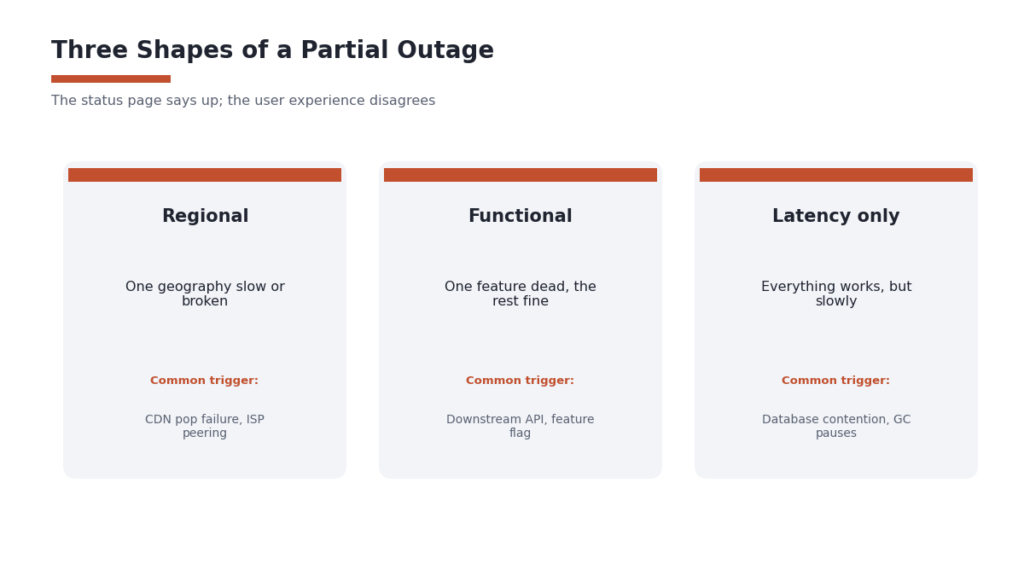
Partial outages sit in the space between total failure and full health. They are usually described along two axes: which slice of users is affected, and which slice of functionality has degraded. Both matter, and mixing them up is how postmortems end up blaming the wrong subsystem. A short reference frame helps engineering teams working with service level objectives keep the conversation precise.
Regional and Segmented Failures
A router misconfiguration in one metro can cut off an entire city while the rest of the country sees no issue. To the global dashboard this is a rounding error. To the users in that metro it is a full outage, and telling them the service is up will only make them angrier.
Feature Level Degradation
Modern products are assembled from independent services. Search, recommendations, notifications, media, payments and analytics each run behind their own deploys. When one of them fails to open, the app keeps rendering but a specific feature quietly stops working. Users rarely file a ticket saying recommendations are stale. They just leave.
Why Standard Monitoring Misses It
Most alerting is built around synthetic checks and infrastructure metrics.
Teams that catch partial outages early tend to invest in a small number of specific signals rather than more dashboards.
● Measure user journeys end to end, not individual endpoints in isolation.
● Alert on error budget burn rate, not on a single failed request.
● Segment every metric by region, device class and network type.
● Track third party dependencies with the same seriousness as internal ones.
● Compare live traffic against a rolling baseline, not against a static threshold.
Health is a property of the transaction the user is trying to complete, not of any component in isolation.
Synthetic Checks Versus Real User Data
Synthetic monitors are cheap and predictable. Real user monitoring fills that gap by reporting from the actual devices and networks in use, including the slow ones nobody in the office is testing on.
Communicating Under Uncertainty
Status pages that only show up or down force teams into a false binary. A three state model, operational, degraded and outage, matches reality better and gives support staff something honest to say. Naming the specific feature that is degraded, the affected region and the current guess at scope does more for trust than any apology template.
Designing Services That Fail Gracefully
The goal is not zero incidents. The realistic goal is to make partial failures feel small to the user. Timeouts should be short enough that a broken dependency does not freeze the whole page. Non essential features should degrade quietly instead of blocking the essential ones. Retries should back off so a struggling service is not finished off by its own clients. And every product surface should have a defined behaviour for the case where a backing service is simply gone. When these habits are in place, the status page and the user experience finally start telling the same story, and up begins to mean what people thought it meant all along.
Stay in the loop with Entireweb
Get the latest updates delivered straight to your inbox. No spam - unsubscribe anytime.